






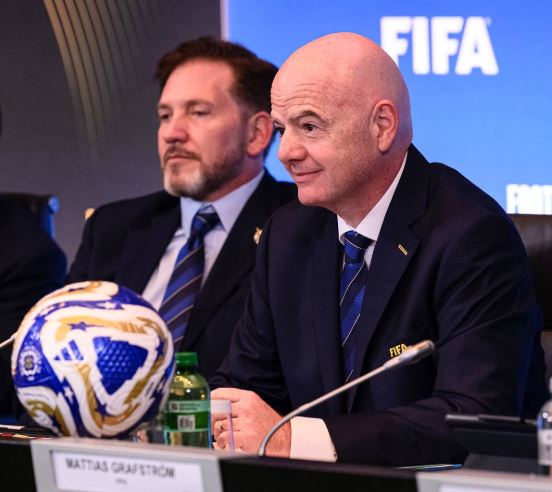
ZURICH, SWITZERLAND — World football’s governing body, FIFA, is facing intense scrutiny and widespread accusations of a double standard in its application of sanctions, contrasting its swift and decisive action against Russia with its hesitation regarding Israel. Critics argue that the disparity in response highlights a fundamental inconsistency that compromises the organization’s claims of political neutrality and commitment to human rights.
Following the large-scale invasion of Ukraine in 2022, FIFA, in coordination with UEFA, took rapid and forceful action, banning the Russian national team and Russian clubs from all international competitions within days. This move was justified by a commitment to stand against violence and aggression, upholding the values of sport.
However, a markedly different approach has been observed concerning Israel amid its military actions in the Gaza Strip. Despite continuous pressure from the Palestinian Football Association, numerous human rights groups, scholars, and several European football federations, FIFA and UEFA have so far refrained from imposing any sanctions. Calls for action have cited the devastating impact on Palestinian football infrastructure and players, as well as the participation of Israeli clubs located in settlements in the West Bank.
When pressed on the issue, FIFA President Gianni Infantino has adopted a position that “football cannot solve geopolitical problems,” stressing the sport’s role in promoting “peace and unity.” This stance has been widely interpreted as an excuse for inaction, particularly given the precedent set with Russia.
Critics argue that the different reactions cannot be attributed to a change in policy, but rather to political and economic considerations. The powerful global political alliances of each nation are seen as a major factor influencing the governing body’s decisions.
The perception of “brazen favouritism” is eroding the credibility of FIFA and UEFA. Opponents of the current policy argue that the speed and severity of the Russian ban demonstrate that the sports bodies can act on principle when global consensus aligns. Their silence and reluctance to take similar steps against Israel suggest that “sport’s norms and principles bend to politics,” as one commentator put it, placing financial and political interests above the stated moral values of the beautiful game.
As the controversy continues to unfold, the global football community watches to see if FIFA will uphold a consistent standard, or if its reputation will be further damaged by what many view as blatant hypocrisy.